
-
 7 min
Build an AI recruiter that recruits like you
For everyone
-
 4 min
Talent Search, the deep dive
For everyone
-
 4 min
Automated interview scheduling
For everyone
-
 4 min
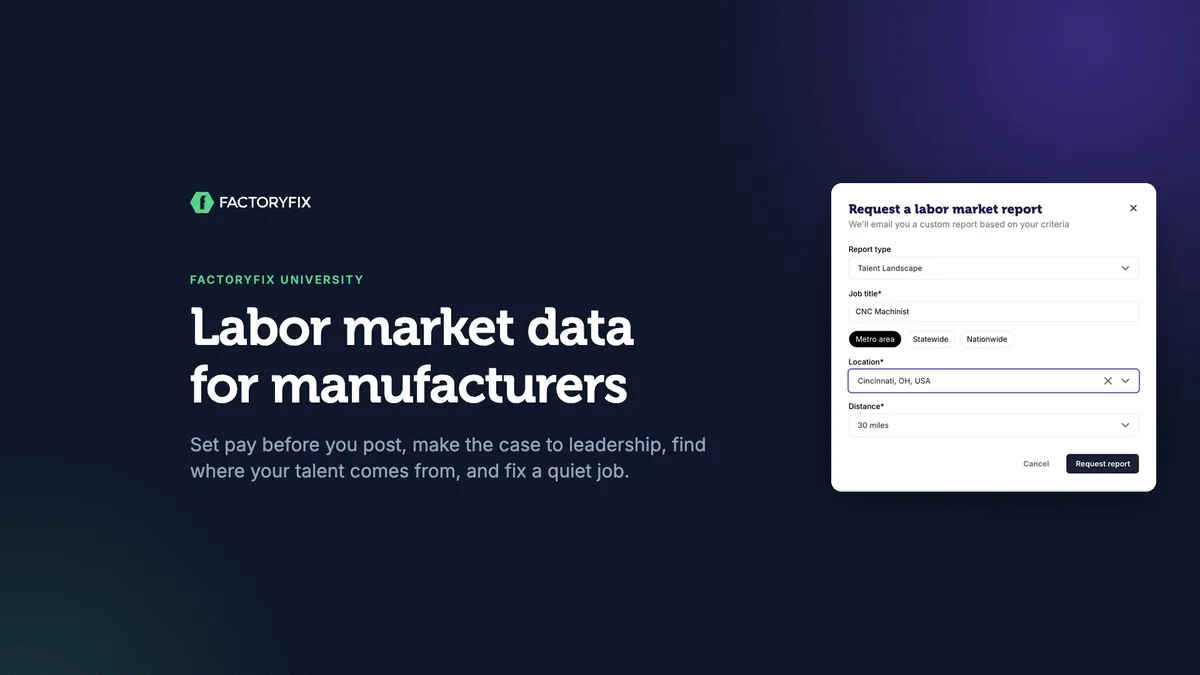
Labor market data for manufacturers
For manufacturers
-
 5 min
Now playing
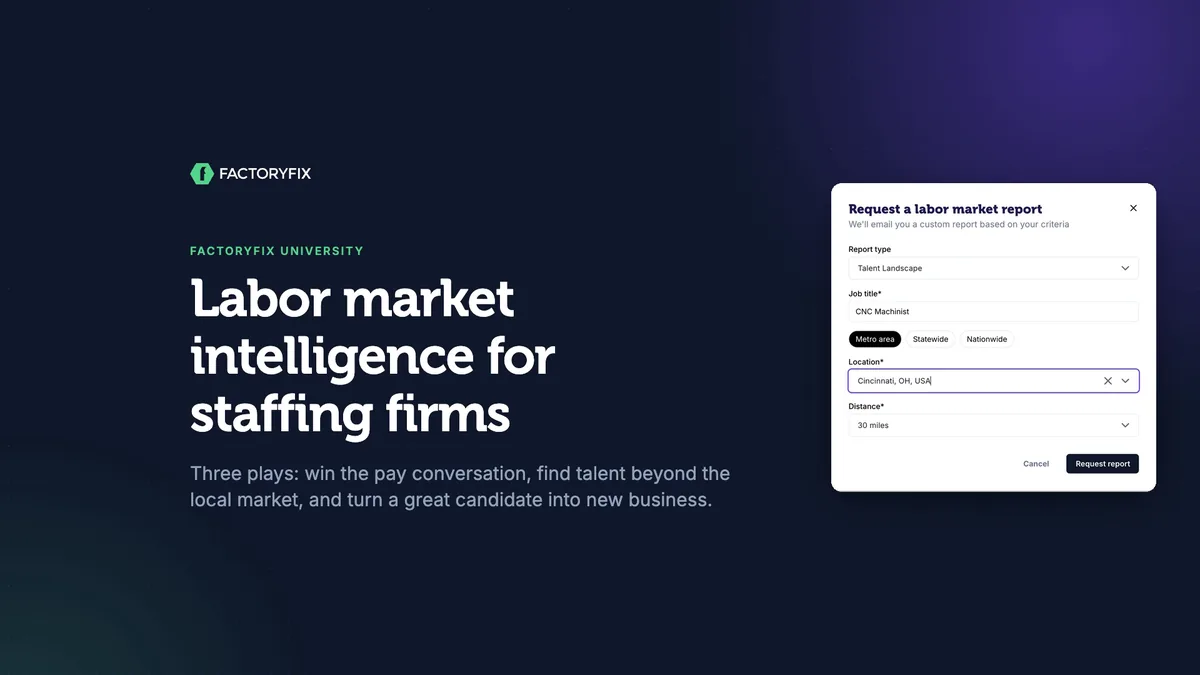
Labor market intelligence for staffing firms
For staffing firms
Your clients can post a job on their own. What they can't easily get is a partner who knows the market, cites sources, and has the right people ready. Labor market reports make you that partner.
Good to know before you start:
- Labor market reports are a Gold feature.
- Anyone on your team can request one: recruiters, account managers, and business development.
- Market reports usually arrive by email within an hour.
Play 1: the pay conversation
A client wants a CNC machinist who does their own setups, in Cincinnati, at $24 an hour. Before you say yes, check the market.
- Click Labor Market Reports in the left menu.
- Keep Talent Landscape and enter the job title.
- Choose Metro area, then the location and the distance (30 miles is the default). You can also choose Statewide or Nationwide.
- Click Request report. You'll get a reference ID, and the report arrives by email.
The report includes:
- an executive summary
- pay by experience level
- supply and demand
- the companies currently hiring, with their advertised pay
- the major employers
- related titles and top skills
- the training pipeline
- numbered references
Take it to the client. Lead with the gap, not a demand: "At $24 you'll attract operators. Machinists who do their own setups are advertised at $29 and up here." Then give them options:
| Option | What to say |
|---|---|
| Raise the rate | Each $1/hr is about $2,080 a year. |
| Hire an operator and train them up | Fill the seat now and build the skill. |
| Widen the search | Look further out (see Play 2). |
Play 2: look beyond the local market
When you've already called everyone nearby, choose Relocation Strategy and enter just the job title and the destination (where the job is).
The report:
- ranks source markets by how likely people are to move, not just by how many people there are
- gives each market a drive time, from local hire to long distance
- looks for recent layoffs and plant closures, and compares housing costs
- ends with talking points for your recruiters
Aim your search with it. In Talent Search, select Open to relocate under Mobility, then click Apply. Lead your outreach with the reasons people in those markets would move.
Play 3: turn a great candidate into new business
Your runner-up for a role was nearly as strong as the person you placed. Don't let them go cold.
- In Talent Search or your Candidate Archive, check the candidates you want to place.
- Click Request Job Match Report. Locked candidates are unlocked first.
Each candidate gets their own report:
| Section | What it is |
|---|---|
| Your Open Jobs | Your firm's own matching public postings, listed first when there are any |
| Priority Calls | The strongest matches: recent openings near the candidate, why they fit, and any concern |
| Secondary Calls | Possible matches, worth a conversation |
| Company Targets | Employers to approach even without a posted opening: your business development list |
Then make the call with a real person in hand: "I have a maintenance tech with six years on packaging lines, right near your plant."
Read the reports like an expert
- Metro, not your radius: government numbers cover the metro area or county.
- Percentiles: a 10th percentile of $23.50 means 1 in 10 earn less.
- Advertised pay: base pay in postings, not total compensation.
- Job Match coverage: public postings from direct employers in the last 30 days, within about 30 miles of the candidate.
- AI research: check a number before you quote it to a client.
- Emailed to you: only the person who asked gets the report, so forward it to your team.
Before your next client call
- Do I know what the market pays for this role?
- Is the local pool deep enough, or should I look further?
- Who's my best available candidate, and who needs them?
Chapters
- 0:00 Introduction
- 0:14 Be the partner who knows the market
- 0:37 Play 1: the pay conversation
- 1:41 Take it to the client
- 2:05 Play 2: look beyond the local market
- 2:46 Aim your search
- 2:57 Play 3: turn a great candidate into new business
- 3:20 What's in a Job Match Report
- 3:39 Make the call
- 3:56 Read the reports like an expert
- 4:25 Before your next client call
Transcript
Labor market intelligence for staffing firms. In about five minutes, you'll learn three plays: winning the pay conversation, finding talent beyond the local market, and turning a strong candidate into new business.
Your clients can post a job on their own. What they can't easily get is a partner who knows the market, and has the right people ready. Labor market reports make you that partner, with sources you can cite. They're a Gold feature, and anyone on your team can request one: recruiters, account managers, and business development. Market reports usually arrive by email within an hour.
Play one: the conversation about pay. A client wants a CNC machinist who can do their own setups, in Cincinnati, at twenty four dollars an hour. Before you say yes, check the market. Click Labor Market Reports in the left menu. Keep Talent Landscape, and enter the job title. Choose metro area, then the location, and how far out to look. Thirty miles is the default. You can also look statewide or nationwide. Request it, and you'll get a reference number. The report comes to your inbox. It opens with an executive summary: the local median, the pay bands, how many people do this work, and who's competing for them. The salary section breaks down pay by experience. Here, senior machinists, the ones who do setups, are advertised at twenty nine to thirty five dollars an hour. At twenty four, the client is pricing for operators. And this table shows what nearby competitors actually advertise. That's your evidence: real employers, real ranges.
Now take it to the client. Lead with the gap, not a demand. At twenty four, you'll attract operators. Machinists who do setups here are advertised at twenty nine and up. Then give them options. Raise the rate. Hire an operator, and train them up. Or widen the search. And make the math easy: each dollar an hour is about two thousand dollars a year.
Play two: when the local market is tapped out, look further. For example, a client needs maintenance technicians in Cincinnati, and you've already called everyone nearby. Choose Relocation Strategy, and enter just the job title and the destination, where the job is. The report ranks source markets by how likely people are to move, not just by how many there are. Each market gets a drive time, from local hire to long distance. It looks for recent layoffs and plant closures, compares housing costs, and ends with talking points your recruiters can use.
Use it to aim your search. In Talent Search, add the Open to relocate filter, and lead your outreach with the reasons people in those markets would move.
Play three: turn a great candidate into new business. Your runner-up for a role was nearly as strong as the person you placed. Don't let them go cold. Check the candidates you want to place, and click Request Job Match Report. You can do this from Talent Search or your Candidate Archive. Locked candidates are unlocked first.
Each candidate gets their own report. Priority Calls are the strongest matches: recent openings near them, why they fit, and any concern. Secondary Calls are worth a conversation. And Company Targets are employers to approach even without a posted opening. That's your business development list.
Then make the call with a real person in hand. I have a maintenance tech with six years on packaging lines, right near your plant. That beats a cold pitch every time. And if your firm has matching public job postings of its own, the report lists those first, under Your Open Jobs.
A few things to know. Market numbers cover the metro area or county, not your exact radius. A tenth percentile means one in ten earn less. And advertised pay isn't total compensation. Job Match looks at public postings from direct employers in the last thirty days, within about thirty miles of the candidate. These reports are AI research, so check a number before you quote it to a client. And they're emailed only to the person who asked, so forward them to your team.
Before your next client call, ask three questions. Do I know what the market pays for this role? Is the local pool deep enough, or should I look further? And who's my best available candidate, and who needs them? Bring the market and bring the person, and you're not just filling orders. You're the partner they call first.
That's this session of FactoryFix University. Find more sessions in the help center.